Просмотр содержимого документа
«Конспект открытого урока на тему: «Проблемы экологии»»
Муниципальное казенное общеобразовательное учреждение
«Гамияхская СОШ»
Новолакский район, с. Гамиях
План-конспект урока
по английскому языку в 7 классе
по теме «Проблемы экологии»
учитель: Багданова Бича Абрамовна
Махачкала 2026
ЦЕЛИ:
Образовательная: формирование коммуникативной компетенции учащихся по теме урока с помощью применения элементов технологии критического мышления, развитие письменной речевой компетенции, развитие навыков чтения и аудирования.
Развивающая: увеличение объёма знаний об экологических проблемах родного города, развитие взаимосвязей с предметами «Биология», «Физика», «ОБЖ», развитие речемыслительной деятельности, развитие критического мышления, расширение кругозора учащихся.
Воспитывающая: развитие мотивации к изучению английского языка, воспитание уважительного отношения к родному городу, формирование качеств гражданина и патриота, развитие умений работать индивидуально, в паре, в группе.
ЗАДАЧИ:
систематизировать знания учащихся по теме «Проблемы экологии»
развивать умения аудирования, чтения и говорения при работе с вопросами анкеты;
развивать умения само- и взаимоконтроля.
Цифровые образовательные ресурсы:
компьютер
интерактивная доска
компьютерная презентация
Мультипликационный фильм по теме урока
Оборудование : учебник «Английский в фокусе», 7 класс. Авторы : Ю.Е. Ваулина, В. Эванс и др., раздаточный материал (карточки) и т.д.
Ход урока
1. Организационный этап.
Приветствие. Вопросы о дне недели, погоде , настроении и т.д
2. Проверка домашнего задания.
Повторение лексики предыдущего урока модуля 8а. Задание на сопоставление слова с его переводом по теме «Экология», учащимся раздаются карточки с английскими словами, надо правильно сопоставить слово со своим значением, найти русский эквивалент), проверка задания – к доске выходит ученик, записывает слово и его перевод, остальные соглашаются или нет)
3. Подготовка к усвоению новых знаний.
Демонстрация мульфильма “Ecologyis…”(2 мин)
Teacher : Today we continue speaking about ecological problems. I want to start our lesson with a short cartoon. Watch it and try to understand what we shall talk about at this lesson.
После просмотра мультфильма учащиеся озвучивают свои предположения о теме урока:
Students :- How can we help our ecology? / What can we do to help the ecology? / Etc.
Тема урока записывается на доске: «How can we help our ecology?»
Показ презентации с анкетой “Ecological problems of our city”.
Teacher : And now let’s find out how you care about the ecology of our city. Look at the screen. Read the task. Be honest when you choose the answer.
Учащимся предлагается ответить на вопросы анкеты. Во время голосования проходит обсуждение вопросов и результатов голосования. Отвечая на вопросы учителя, учащиеся вспоминают и активизируют ранее изученную лексику по теме.
Задание: Agree or disagree with these statements and choоse the variant close to you.
1. Our city has ecological problems.
A lot of.
Only a few.
I’ve never thought about it.
What kind of problems can you name?
2. I have collected the rubbish in our local park, in the streets of our city.
Sometimes, with my classmates.
Yes, of course.
Never. It’s not my duty.
Is there a lot of rubbish in our streets? Why?
3. I have planted trees.
Yes, I’ve done it.
I’ve never done it.
It’s not my duty to make the town nice.
Can we call our city green?
4. I don’t understand people who wash their cars near our lake or river.
It’s awful.
I don’t care about it.
I’ve washed my dad’s car near the river.
Why it is dangerous to wash a car near rivers?
5. I always throw rubbish in the bins walking around the city.
Yes, of course.
To tell the truth – not always.
If there is a bin not far from me.
Are there enough bins for rubbish in our city?
6. Who must take care of the ecology of our city?
Our local authorities.
People who live in this town.
I mustn’t
What is the right answer to this question?
4 . Усвоение и осмысление новых знаний.
Teacher : Now I want you to know about one club where children have gathered to help the ecology of their city. Open your books at page 78. Look at the picture and tell what they do to help the environment.
Учащиеся составляют предложения, используя лексику, данную в упражнении:
Students:John is collecting rubbish. / Dave is planting flowers./
Teacher : Now let’s listen to the dialogue between two friends. One of them is the member of this club.
Учащиеся слушают аудиозапись диалога.
Teacher : In the dialogue there are some words in bold which we should explain. Do it in pairs. Find their meanings in the word list .Explain them and compare them with my variant.
Учащиеся, работая в парах, переводят новые слова, находят им более знакомые синонимы или объясняют их значение. Затем сравнивают свои варианты с предложенными.
to join – to become a member
to recycle – to reuse,
a nest – a home for birds
volunteers – people who do something for free
to leave – to go away.
Teacher : Look at the screen. Read the dialogue again. Are these sentences true or false? Correct the mistakes.
Tim has joined the eco- helpers club. (T)
They collect the rubbish for recycling in the park. (T)
Dave builds nesting boxes to make birds leave the city.(F)
When the weather isn’t good they usually plant trees.(F)
Tim can’t join this club. (F)
Teacher : Look at the screen and match the sentences. What do the volunteers do? Why do they do it?
1Children have joined the eco-club
to help the nature
2Theн collect the rubbish in the park
to make the city park clean
3They build nesting boxes for birds
to help them survive in the city
4 They clean out the ponds in the park
to help water inhabitants live there safely
5 They plant trees
to make their city nice and attractive
5.Закреплениеполученныхзнаний.
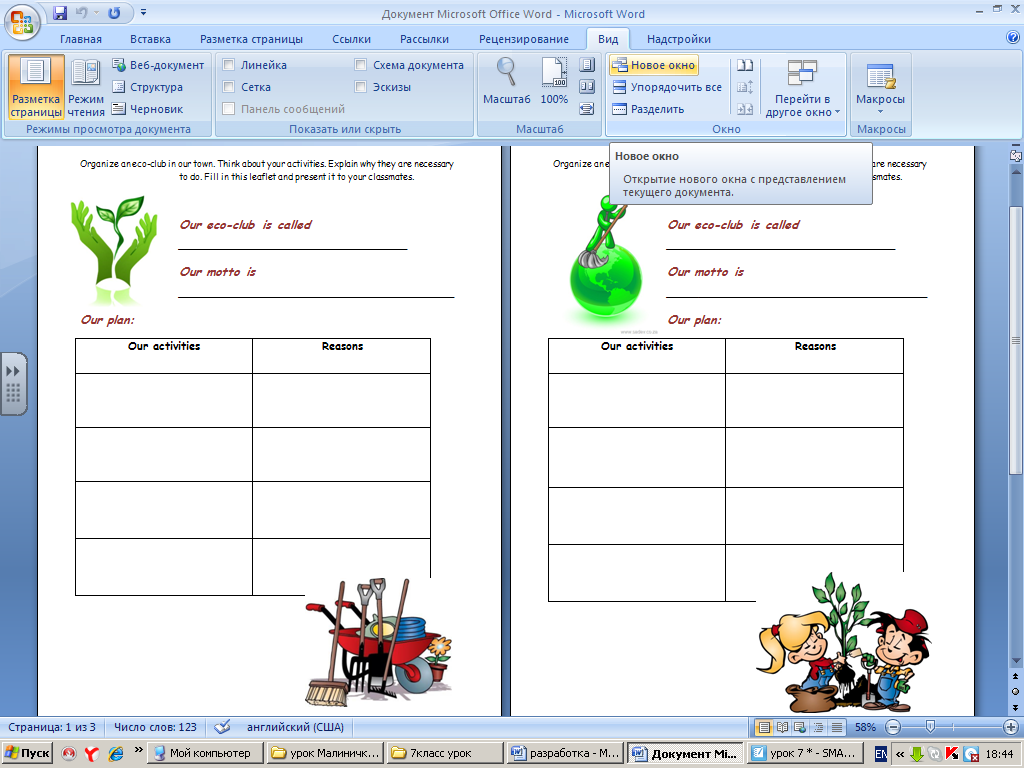
Teacher : Do you think that these children do a lot of good things for their city? Imagine that you have a chance to organize such a club in our town. Make up a plan of your activities to make our town more beautiful and healthier. Work in groups. Tell us what you are going to do and why you will do it? (Учащиеся, работая в группах, заполняют шаблон проекта. Затем каждая группа представляет свой проект эко-клуба. Сначала выступает одна группа, потом другая.
Объяснениедомашнегозадания.
Teacher : You should do at home Ex 9 p 79 at home (Оrganize an eco-helpers group. Write a list of activities for the group for next weekend and explain why it is important to do.
Рефлексия. (Учащиеся отвечают на вопросы):
Is the topic of the lesson interesting for you?
What phrase can sum up our lesson better:
“Ecology is our future”
“If you want ecology – give an example”
“Small actions + a lot of people = big change!”
Заместитель директора по УВР____________________/Г.Г. Коржева/